


The Only Grief Timeline that Matters: Past, Present, and Future
/ General : Eleanor Haley
For further articles on these topics:
Sometimes I write down thoughts I have about grief so I don’t forget them. They often come to me in the shower — the one place where writing doesn’t work. So I’ll quickly type the note into my phone afterward, but 8 times out of 10, I forget about it, and when I stumble across it later, I have no clue what it means. It’s like a great idea you had in a dream — brilliant in the moment — but upon waking, it seems unintelligible.
Today, I’m mulling over a note I wrote in November of 2022:
“The only 'grief timeline' that matters - past, present, future.”
Hmmm…now what did 2022-me mean by this?
I don’t believe in grief timelines, so that’s not a good clue.
But “past, present, and future grief.” I do remember chewing this over, and now that I think about it, I have the vague recollection of recording a podcast around this time called “Grieving the Past, Present, and Future.” I could go back and listen, but I don’t enjoy the sound of my voice.
That’s okay because I think I recall that around this time I started mulling over the multidimensionality of grief. As mentioned, I don’t believe in grief timelines, but I understand why we crave them. Our brains tend to organize events and experiences around a narrative arc.
In many ways, it’s common sense to think of grief as a story that begins with a loss and carries through until you reach some place of peace or resolution. I believe this is one of the reasons why theories like the Five Stages of Grief took off; whether intended or not, they left people with the sense that grief was like a story with a beginning, middle, and end. But as we all know by now (don’t we?), grief doesn’t work like that. It’s messy and complex, and there’s nothing linear about it.
Personally, I’ve come to think of grief as more of a diffuse presence. Once it enters your life, you can find it everywhere. And most relevant to our discussion today, grief is a time traveler. When loss occurs, it is felt intensely in the here and now, but it can also jump timelines. It can reach into the past and cast its hue over events that occurred before the loss. Conversely, it can hop into the future and change how you feel or think about things to come.
Grief in the past, present, and future
We've written in the past about how enormous grief is when someone dies, and thinking about grief's impact on the past, present, and future is just an added dimension. The overarching point is that grief is never just one thing. Grief is felt towards so many things after a significant loss - its radius is massive. It’s important for people to know this because it normalizes why someone might feel so overwhelmed and lost for such a long time.
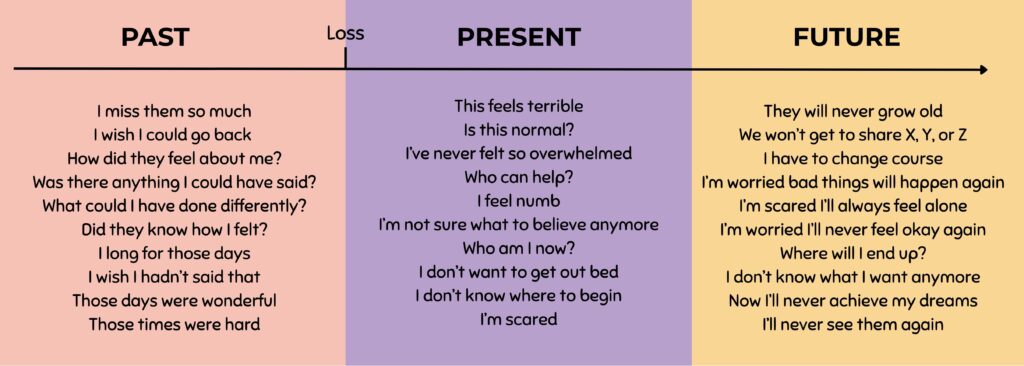
Grief in the present:
Grief in the present encompasses all the grief-related thoughts and emotions you're dealing with in the here and now. Present grief is typically most intense in the year or two following a loss, but it's normal to experience periods of time, even years later ,where your grief feels especially intense. Grief in the present includes:
- Adjusting to changes in day-to-day living
- Taking on new roles and responsibilities
- Relearning how to see the world and the people in it
- Coping with an onslaught of new and intense grief-related thoughts and emotions.
Grief about the future:
Grief about the future is again something that may feel especially intense at the beginning of grief. When loss turns a person’s world upside down, it triggers great uncertainty about the world and what is to come. Not only do you grieve for the loss of the person’s future, but you may also grieve your own imagined future. Grief about the future may include things like:
- Feelings of sadness and loss about what will never be
- Grieving the loss of hopes and dreams for the future
- Grieving future milestones they will miss
- Fear and uncertainty about what the future holds
- Anxiety that bad things will continue to happen
Grief about the past:
When grieving, it’s common to spend a lot of time thinking about the past. Personally, I find that grief over the past is where I most often return to. When the intensity of present-moment grief subsides, and uncertainties about the future have resolved, we are left with the past and the people and places we cannot return to. Grief about the past could include:
- Thoughts and feelings about treasured people, places, and memories
- Regret over things said and done
- Regret over things left unsaid
- Distress over unresolved conflicts
- Wishing things could have been different
- Grieving what you didn't have in a relationship
- Comforting memories
- Longing and yearning
- Wishing to have one's youth back

We invite you to share your comments and questions with the WYG community in the discussion section below.




Karen G March 17, 2026 at 10:41 pm
Eleanor, I love the idea of grief as a time traveler. In my work as a grief counsellor, I see this constantly. A client will come in grieving the present loss of their mother, and within 20 minutes we are talking about the future birthday she will not be at, and then a childhood memory surfaces that they suddenly see differently because of the loss. All three timelines hit at once.
The past grief is the one that surprises people the most. Nobody warns you that losing someone will change how you remember everything. A perfectly happy memory from ten years ago now carries weight it never had before. Not because the memory is sad, but because you now know it was part of something finite.
I find that the future grief tends to ease over time. New futures form, even when you didn’t think they could. But the past grief? That one is a permanent companion. Not in a cruel way, but in the way that any deep love leaves a mark on how you see the world.
Thank you for continuing to put language around what so many people feel but struggle to name. I share your work with my clients regularly because it validates what they are going through in a way clinical resources often don’t.
Karen G March 11, 2026 at 11:07 pm
This really resonated with me. I’ve been working as a grief counsellor for over twenty years and the timeline question comes up constantly. Families always want to know “when will this get better” and the honest answer is that it doesn’t follow a schedule.
The part about grief reaching into the past hit especially hard. I see this all the time with the people I work with. A death doesn’t just change your future, it actually changes how you remember everything that came before. Suddenly old memories have a different weight to them.
I’ve found that helping families create some kind of tangible memorial, whether it’s a physical space at home or an online tribute, gives them a way to hold the past, present, and future of their grief in one place. It doesn’t fix anything but it gives the feelings somewhere to live outside of your head.
Thank you for writing this. I’ll be sharing it with some of the families I support through my practice [links not allowed]. It puts into words something I’ve been trying to explain for years.
Jude February 27, 2026 at 6:44 pm
God, all that is so true…sometimes overwhelming. Have so many loved ones that have died, my parents, brother, husband and son. I have feelings for all of them, past, present, future thoughts and regrets…Thank God they dont all come upon me at once. Grief for me is a full time job, at times. Its always there, but its the price I pay for loving…so im ok with that. Thanks for all you guys do….im not alone. And that helps….judy